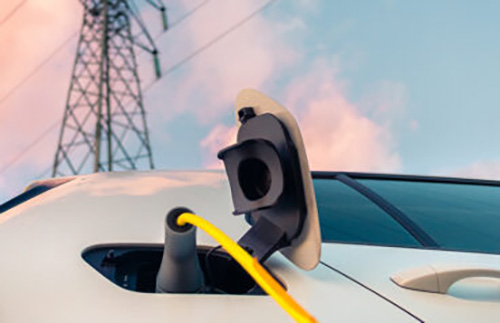
UL Solutions announced its new certification program for vehicle-to-grid (V2G) technology, aimed at promoting the use of electric vehicles as grid resources.
Utility companies are seeking new ways to manage rising electricity demand, integrate renewable energy sources, and enhance grid resilience. V2G technology can help by enabling parked electric vehicles to feed power back into the grid during high-demand periods and charge when demand is low.
A recent E3 study on vehicle-to-grid integration, commissioned by General Motors, estimates that in many markets, the value of V2G (vehicle-to-grid) could be five to fifteen times greater per vehicle than one-way managed charging. According to a study by the Electric Power Research Institute, under typical driving conditions, approximately 90% of electric vehicles are parked at any given time. This allows participating vehicles to charge when demand is low and return stored power to the grid when additional support is needed. As electricity demand grows in data centers, transportation, buildings, and industries, this flexibility helps reduce peak demand, ease pressure on local infrastructure, and enables the grid to utilize available power more efficiently.
Wesley Guo, Vice President and General Manager of UL Solutions Energy and Industrial Automation Group, said, "Electric vehicles spend most of their time parked, which opens up more possibilities beyond mere transportation. Vehicle-to-grid (V2G) technology can transform this unused battery capacity into a valuable resource for utility companies and communities. Our new certification program helps build confidence, ensuring these V2G systems operate safely and reliably while delivering critical utility performance."
The program allows for testing and certification of products according to UL 1741 SC (the latest supplement to UL 1741), which is the "Standard for Inverters, Converters, Controllers, and Interconnection System Equipment for Distributed Energy Resources." This new certification program targets bidirectional electric vehicle supply equipment capable of achieving these interactions.
The device serves as a bridge between electric vehicles and utility companies, facilitating the monitoring and management of power flow while ensuring compliance with utility grid connection requirements. Products certified with UL 1741 SC supplementary approval can be used in conjunction with electric vehicles equipped with onboard bidirectional inverters designed and tested according to SAE J3072.
Products can also obtain grid interconnection and performance support certification by combining the new UL 1741 requirements for multi-component distributed energy resources with UL 9741 ("Standard for Electric Vehicle Power Export Equipment").
These testing and certification services are available at UL Solutions laboratories located in Fremont, California, and Northbrook, Illinois.

 français


 Système de montage au sol
 système de montage sur le toit
 Système de montage d'abri d'auto
 système de montage agricole
 Easy Solar Kit
 système de suivi solaire
 Onduleur solaire
 Accessoires solaires
 RM502, Sihai Smart Zone, No.189, Fanghu West Road, Huli District, Xiamen, Fujian, China.